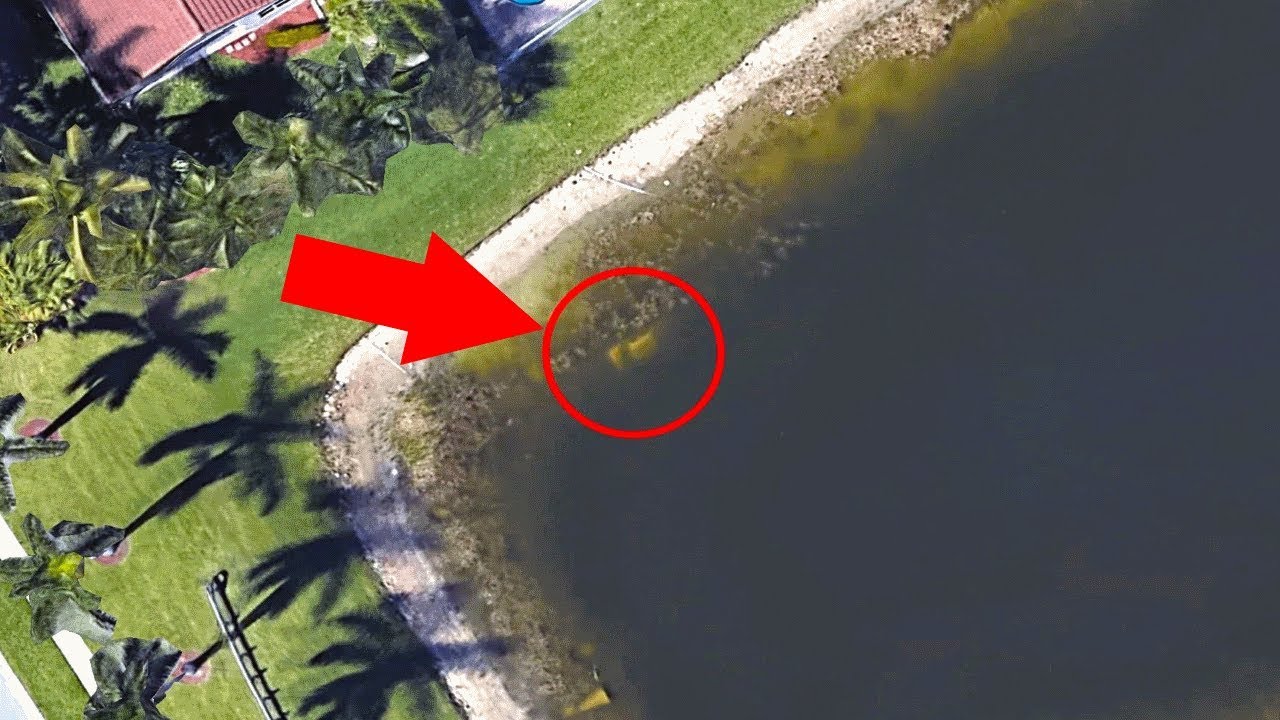
The incredible tale began in August 2019 when a property expert was scouting out his old Florida neighborhood on Google Earth. Poking around where he used to live, he clicked onto the area behind one of the houses and then noticed something totally out of the ordinary. There, submerged in a pond, was what appeared to be a vehicle.
Well, that’s what it looked like to the digital explorer at least. After all, there was no way to be sure exactly what he was dealing with from just the blurry image on Google Earth. But when the man got in touch with his ex-wife, who reportedly still lived at his old address, she was able to confirm through a neighbor that it was indeed a car.
The real spine-chilling discovery, however, awaited them inside the vehicle. As this Florida resident learned, you don’t need a degree in archaeology or a hat and whip to call yourself an explorer these days. Yes, if Indiana Jones were set in the 21st century, it might just involve Harrison Ford sitting at a computer, because all you really need today is an internet connection to make some astonishing discoveries.
For proof, look to the countless strange findings that people have made using Google Earth. In 2005, for instance, a group of researchers from London’s Royal Botanical Gardens identified a previously undocumented mountain using Google Earth. Mozambique’s mysterious Mount Mabu stretches upwards 5,600 feet and houses what’s thought to be Southern Africa’s biggest mid-altitude rainforest.
Yet prior to this phenomenal discovery, scientists had been completely unaware of it. In fact, Mount Mabu had stood largely untouched by people for potentially the entirety of humankind’s existence, its presence known only by locals. The peak was entirely hidden by savanna, which also cut it off from external ecological influence.
It was spotted by conservation biologist Julian Bayliss, who was using Google Earth to search for biodiverse locations in Africa that had yet to be discovered. In 2008, a team of 28 researchers led by plant expert Jonathan Timberlake headed to Mount Mabu to explore the lost region.
In a press release, Timberlake said: “The phenomenal diversity is just mind-boggling. Even today, we cannot say we know all of the world’s key areas for biodiversity. There are still new ones to discover.”
All in all, the team collected over 500 specimens of plant life and made several new discoveries, including new species of plants, butterflies, snakes, and crabs. And perhaps none of this would have occurred without Bayliss firing up Google Earth.
But Bayliss’s discovery isn’t the only one credited to Google Earth. Back in 2007, Professor Lee Berger of the University of the Witwatersrand used the program to identify the coordinates of caves and fossil locations. In doing so, he happened upon hundreds of previously unknown sites and even discovered a groundbreaking pair of skeletons.
These remains, found in South Africa’s Cradle of Humankind, dated back at least 1.78 million years and were identified as belonging to a new species of hominid, Australopithecus sediba — a likely ancestor of modern humans.
Google Earth has also helped researchers in other ways. In 2009, after a pilot spotted an unusual shape in a riverbed in Wales, archaeologists used satellite images to identify a structure that had lain hidden for more than 1,000 years — a man-made fishing trap.
Some discoveries are less groundbreaking but still fascinating. For example, Lake Taal in the Philippines contains one of the world’s only known “third-order islands” — an island within a lake on an island within a lake. Another example was later found in Canada using satellite imagery.
Not all findings, however, are real discoveries. Some strange images have led to false theories, such as claims that the lost city of Atlantis had been discovered on the ocean floor. In reality, the grid-like pattern seen was just overlapping sonar data used in mapping.
There are also mysterious natural phenomena. In Iran, for instance, a lake appeared blood-red on satellite images. Scientists later explained that the color change was caused by bacteria that thrive in high-salinity water, producing red pigments under certain conditions.
Still, not every strange sight can be explained naturally. Some are man-made — like a massive inscription of a billionaire’s name carved into desert land, once visible from space.
But returning to that Florida discovery in 2019 — the story takes a darker turn. The man who spotted the car contacted his ex-wife, who then spoke to a neighbor. The neighbor used a drone to investigate and confirmed that there was indeed a vehicle submerged in the pond.
Authorities were called to the scene. When the car was pulled from the water, it was found to be heavily calcified, indicating it had been there for a long time. Inside, investigators discovered human skeletal remains.
The remains were later identified as William Mold, a man who had gone missing in 1997 after leaving a nightclub. His disappearance had remained a mystery for over two decades.
Thanks to this discovery, a 22-year-old cold case was finally solved. It’s believed that Mold may have lost control of his car and accidentally driven into the pond, though the exact circumstances remain unknown.
Amazingly, the car had actually been visible on Google Earth images for years — but no one had noticed it.
And Mold’s case isn’t unique. In Canada, the remains of a woman missing since 1992 were also discovered decades later when a submerged car was found in a lake.
These stories are both fascinating and unsettling. They show how modern technology like Google Earth can uncover long-hidden mysteries — sometimes by pure chance. And they leave us wondering: what else might still be out there, waiting to be discovered?